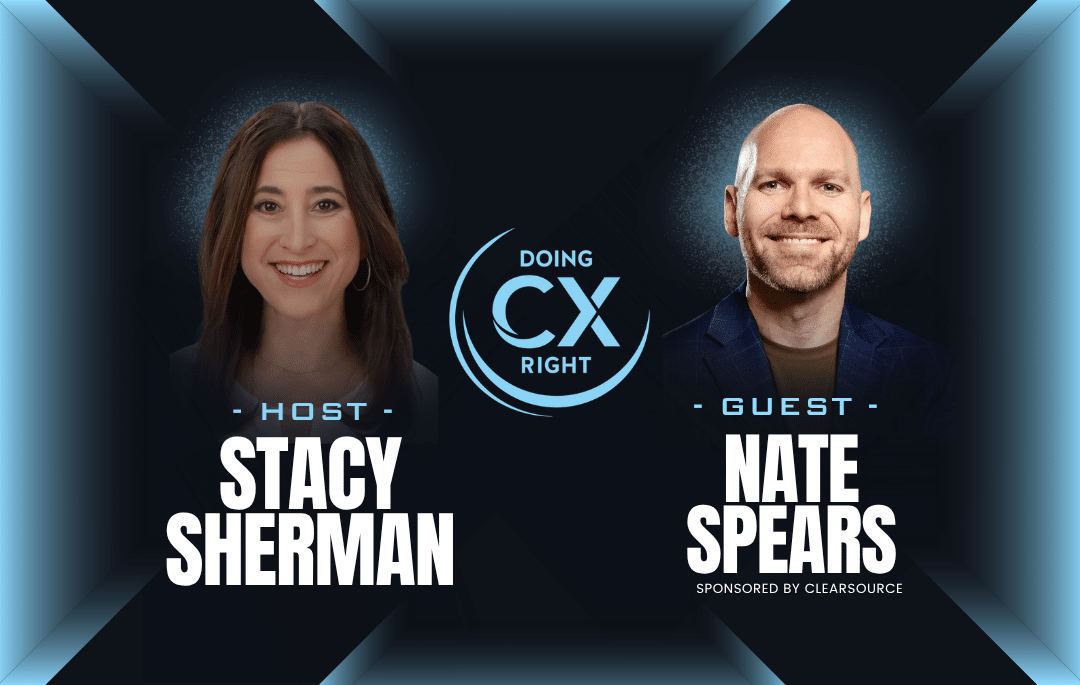
Most companies think the next piece of technology will finally set them apart from the competition. Nate Spears, Co-Founder and COO of ClearSource, has heard that theory plenty of times — and in his conversation with Stacy Sherman on the Doing CX Right® podcast, he explains why it rarely holds up. AI, automation, and speech analytics are no longer a competitive edge. Everyone has access to the same tools. The differentiator that’s left is the one thing software can’t replicate: the people answering the phone.
As AI takes over the simple, repetitive inquiries, the calls that reach a human agent are the hard ones — the frustrated customer, the ambiguous problem, the situation with no script. Spears argues that winning in this environment isn’t about adopting more tools. It’s about building a culture strong enough to make people want to do their best work when it matters most.
What’s Left When AI Takes the Easy Calls
Call deflection technology is good at what it does: routing password resets, order status checks, and simple lookups away from live agents. But that means the volume reaching the frontline is increasingly made up of complex, emotionally charged interactions. Spears points out that this shift raises the skill bar for agents rather than lowering it. Companies that treat their frontline as a shrinking, less-important function are misreading the moment — the human side of service is becoming more valuable, not less.
A Five-Part Formula for Building Winning Teams
At the center of the episode is a practical framework for building teams that outperform on the moments technology can’t handle. It starts with aligning the entire organization behind one scorecard, so departments stop optimizing for conflicting goals. From there, Spears walks through how to hire for character over polish, how to keep performance metrics honest, how to use feedback to find root causes instead of symptoms, and how leaders can model the effort they expect from their teams.
Hiring for Humble, Hungry, and Smart
Spears recommends retiring the standard “tell us about your greatest achievement” interview question. It’s rehearsed, and it rarely reveals how someone actually behaves under pressure. Instead, he suggests asking candidates to describe a time they worked hard for something, or a time they received feedback they didn’t want to hear. The answers surface the traits that predict success on a frontline team: humility, hunger, and the ability to take a hit without getting defensive. The same lens, he adds, should guide who gets promoted — and who doesn’t stay.
“Everybody has the same equipment. The winning teams are the real differentiator.” — Nate Spears
Fixing the Metric Everyone Fears: Average Handle Time
Few metrics generate more anxiety on a frontline team than average handle time. Spears reframes the conversation: instead of treating it as a speed target, leaders should ask what amount of time actually respects the customer and solves the problem well. That number becomes the real target. When an agent misses it, the useful question isn’t why they broke the rule — it’s what got in their way. That single shift turns a metric used to punish agents into one that helps identify friction in the process.
Turning KPIs From Weapons Into Warning Lights
Spears uses a simple analogy: a check-engine light doesn’t tell you what’s wrong with the car, only that something needs attention. He argues KPIs should work the same way. Too often, leaders treat a missed metric as proof of a problem rather than a signal to go find one. Combined with NPS scores and verbatim customer comments, this approach helps teams trace a dip in performance back to its actual root cause — a broken process, a confusing policy, a gap in training — instead of assuming the agent is simply underperforming.
Discretionary Effort Starts With Leadership
Using the now-famous example of The Farmer’s Dog and its customer service reputation, Spears defines discretionary effort as the extra step people take when nobody is forcing them to. That effort can’t be mandated — it has to be modeled. He challenges leaders to ask “who is my customer?” about their own team the same way they ask it about external customers, and to demonstrate the same effort they hope to see, whether that means never canceling a one-on-one or showing up early to remove an obstacle for someone on their team.
The Takeaway
Technology will keep leveling the playing field. Spears’s argument is that the companies pulling ahead aren’t the ones with the newest AI stack — they’re the ones whose people actually want to deliver a great experience. That’s built through hiring, metrics, feedback, and leadership behavior, not software licenses. It’s also the one advantage a competitor can’t buy off the shelf.
About Nate Spears
Nate Spears is Co-Founder and COO of ClearSource, a global CX and BPO company blending AI, speech analytics, agent assist, and workforce management with the human side of customer service. Learn more at clearsourcebpo.com.
About Stacy Sherman
Stacy Sherman is a Certified Speaking Professional (CSP®), creator of the Doing CX Right® framework, and host of the top 2%-ranked Doing CX Right® podcast. Her CX strategies have generated $2.4 billion in savings for brands including Verizon, AT&T, and Schindler Elevator Corporation.